Ban on Items in Communal Areas

As part of our ongoing efforts to maintain a safe living environment for everyone at East Village, we’re making some important changes to how our communal areas are managed. In line with updated fire safety regulations, residents are advised that the following items are strictly banned from all communal areas:

  • Ring doorbells
  • Doormats
  • Posters/pictures on doors and walls

This is in addition to electric bikes and scooters which are already prohibited in communal areas of all buildings at East Village. This includes the storage and charging of e-bikes and e-scooters in lobbies, corridors, stairwells, car parks and bike cages.

This decision has been made in line with our ‘zero tolerance’ fire safety policy, which prohibits the storage of personal items in common areas which form part of the escape route. These  areas must be kept completely clear to ensure they remain free of combustible materials, ignition sources, and obstructions in event of an emergency.

This zero tolerance approach is recognised by enforcing authorities and insisted upon by the London Fire Brigade. It plays a crucial role in:

  • Preventing accidental fires
  • Removing potential fuel sources
  • Ensuring quick and safe evacuation

We strongly encourage all residents to strictly follow these guidelines.

No exceptions will be made.

Adhering to this notice will help to keep you, your family and your neighbours safe. We thank you for your cooperation and support.

If you have any questions regarding staying safe in your apartment, please email the EVML team at [email protected].
Understanding simultaneous evacuation strategies: what they are and when they’re used

In the world of building safety, fire strategies are a critical part of our work to keep you safe. One such strategy, simultaneous evacuation, has become more commonly referenced in recent years, particularly in buildings where interim safety measures are in place. But what does it actually mean?

What is a simultaneous evacuation strategy?

Simultaneous evacuation means that if a fire is detected in a building, everyone inside is instructed to leave at the same time. This is different to other strategies like “stay put,” where only those directly affected by a fire are told to evacuate, while others should remain in place unless told otherwise.

Why is it used?

Simultaneous evacuation is typically used in buildings that do not have sufficient fire protection measures to support a stay put strategy. If your building is in a simultaneous evacuation strategy, you will have received a letter detailing why.

For example, buildings with identified fire safety risks may move from a stay put policy to a simultaneous evacuation to ensure everyone can get to safety quickly in the event of a fire. This can also be the case whilst repairs are being undertaken to fire safety equipment, such as Automatic Opening Vents (AOVs).

How does it work in practice?

To support a simultaneous evacuation strategy, the following measures are usually put in place:

  • 24/7 waking watch patrols or an alert system (such as fire alarms) to detect fire and alert residents
  • Waking watch officers will use a loud hailer to announce an emergency
  • Evacuation officers to support residents to evacuate the building
  • Clear signage and escape routes
  • Clear communication to aid in resident understanding of what to do in an emergency

What should residents know?

If you live in a building with a simultaneous evacuation policy, you should:

  • Know all available escape routes
  • Keep communal areas clear and do not prop open fire doors
  • Make sure any support or accessibility needs have been communicated to your landlord

The bigger picture

While simultaneous evacuation is often seen as a short-term solution, it plays an essential role in ensuring the safety of residents in buildings that are undergoing, or awaiting, fire safety remediation. The ultimate aim is to restore the building to a condition where a stay put strategy can safely be reintroduced.

If you’re unsure about the evacuation policy in your building or  for the most up-to-date information on your building’s fire safety risks, visit your individual building page at www.evml.co.uk.

How to Use Lithium Batteries Safely at Home

Lithium batteries power many of the devices we use every day – phones, laptops, e-bikes and even some white goods. Therefore, we understand that every home at East Village will have a number of items powered by lithium batteries.

However, when not used correctly, they can become a fire risk.

Here’s what everyone at East Village should know about keeping safe while using lithium batteries in your home.

Charging E-Bikes and E-Scooters

Most fires involving e-bikes or e-scooters start during charging, often in homes.

At East Village, there is a complete ban on storing and charging e-bikes and e-scooters in communal spaces. This includes lobbies, corridors, stairwells, car parks and bike cages. Not only can they pose a fire risk but could block the escape route in an emergency. Our team of building managers check the buildings daily to ensure corridors and escape routes are clear.

We also strongly encourage all residents to avoid storing or charging e-bikes/scooters inside their apartment.

To stay safe:

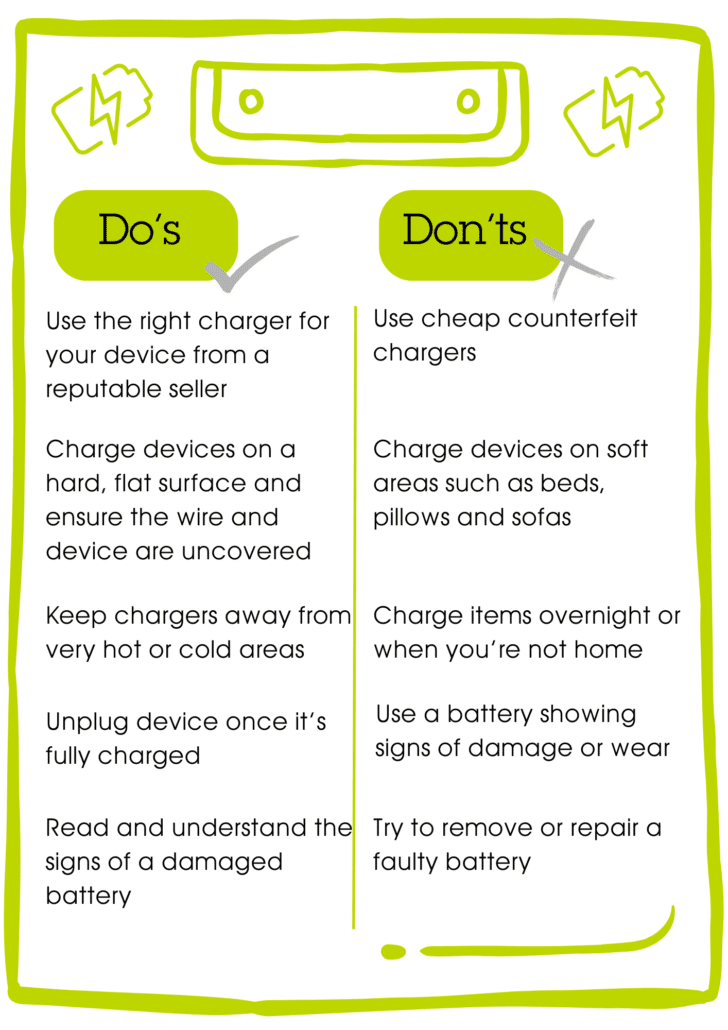
  • Let the battery cool after use before charging, and keep it in a cool, well-ventilated area.
  • Don’t leave batteries charging unattended or overnight.
  • Don’t charge your battery near flammable or combustible materials.
  • Make sure your charger and battery meet UK safety standards and follow the manufacturer’s instructions when charging the battery.
  • Regularly check your battery for signs of damage and don’t continue to use it if it is damaged.

Signs Your Battery Could Be Damaged

If you notice any of these signs, stop using the device immediately:

  • Swelling or bulging in the battery
  • Leaking, hissing or cracking noises
  • A strong, unusual smell
  • The battery feels extremely hot to touch
  • The device is taking far longer than normal to charge – or not charging at all
  • Smoke – if this happens, a fire may have already started. Please leave your apartment and call 999.

Do not try to remove or repair a faulty battery yourself.

Other Safety Advice

Always Use the Right Chargers

  • Only use the charger that came with your device. The original charger is designed specifically for that battery.
  • If you need a replacement, buy from a reputable seller and choose a genuine branded product (ideally the product manufacturer). Chargers from other companies (which are often much cheaper) may look similar but can increase the risk of causing fire.
  • Avoid leaving devices plugged in overnight or after they’re fully charged – this increases the risk of overheating and fire.

Be Aware of How You Store and Use Batteries

  • Keep batteries away from very hot or cold temperatures – don’t store them near radiators or windows.
  • Don’t charge on soft surfaces like beds or sofas. Use a hard, flat surface so heat can escape more easily.
  • Make sure chargers and devices are uncovered while in use to prevent them from overheating, this includes any wires.
  • Protect batteries from damage – don’t place heavy items on top of them, drop/throw them, or expose them to water.

General Electrical Safety Tips

It’s not just batteries you need to be careful with. Here’s some essential advice for all the electrical devices and appliances you may have within your home:

  • Buy electrical appliances with a British or European safety mark.
  • Avoid overloading sockets and stick to one plug per socket for high-powered items.
  • Use the correct fuse – if in doubt, check LFB’s online fuse guide.
  • Clean tumble dryer filters regularly and let hair tools cool on heatproof surfaces.
  • Unwind extension cables fully to prevent overheating.
  • Register white goods with the manufacturer – this way, you’ll be notified if there’s a safety recall.
  • Talk to your household about fire safety – make sure children’s devices and chargers are in good condition and everyone knows how to stay safe around electrics.

Your Safety, Our Priority

Following this guidance doesn’t just protect your own home – it protects your neighbours’ too.

Take a moment to check your devices, chargers, and sockets. Share this advice with others in your building. And remember if you ever spot signs of battery failure, don’t take risks – switch it off, get help, and stay safe.

For more fire safety tips, visit the London Fire Brigade website.

If you have any questions regarding staying safe in your apartment, please email the EVML team at [email protected].

 

Balcony Safety

Our priority at East Village is the safety of our residents. We want you to be able to enjoy everything the community has to offer, but it is important this is done safely.

Throughout the development there are a range of measures to better protect all residents, and it is vital that any observed issues with these measures are reported immediately. This could include any damage to fire doors, alarms and emergency lighting.

The East Village Security Team monitor the use of balconies daily and have outlined some instructions to follow in order to keep yourself safe whilst outdoors.

Fire hazards on balconies can range from discarded cigarettes to barbeques, so it’s vital that these are not present. No barbeques or cooking equipment should be stored or used on balconies, and gas cylinders or anything containing a flammable substance shouldn’t be stored outside.

Also not permitted on balconies are fairy lights, lanterns, screening and indoor furniture – such as rugs, sofas. The only furniture outdoors should be made of metal or hardwood.

A full list on the proper use of balconies is below:

  • No barbeques or cooking equipment of any type should be stored or used.
  • Do not smoke on balconies, in terraced areas, on winter gardens or in internal communal areas.
  • Do not use gas or electrical patio heaters or a firepit.
  • Do not store gas cylinders or any item containing flammable liquid.
  • Do not use fireworks, including indoor fireworks.
  • Do not use candles, lanterns, garden torches or any other form of naked flame
  • Any additional timber, plastic, or other types of materials or screening must not be fixed to balconies, winter gardens or external walls.
  • Do not install electric lights, e.g., fairy lights, whether they be mains, battery or solar powered.
  • Indoor furniture, e.g., sofas, floor coverings or rugs made of combustible material, are not permitted.
  • White/electrical goods such as fridges and tumble dryers should not be stored. They are not suitable for outdoor use.
  • Do not store or charge disability scooters.
  • Do not store bicycles on balconies
  • Do not store combustible materials including paper, cardboard or wood; keep items to a minimum by removing any rubbish and combustible items like furniture, timber, decorating materials, children’s plastic toys and other clutter.
  • Ensure any plants are kept well-watered and not allowed to dry out.
  • Ensure any plants pots/planters are ceramic or terracotta only.
  • Live plants should be used rather than artificial ones.
  • Ensure all blankets, cushions and other fabrics are removed when not in use.